Crunchboard is one of the most recognized names in tech recruitment, serving as the official job board of TechCrunch, the influential media brand that has chronicled Silicon Valley’s rise since 2005. For startup founders, recruiters, and job seekers alike, Crunchboard represents a direct line to a highly engaged, technology-savvy audience. Unlike a typical biography of a single person, the story of Crunchboard is really the story of a platform built inside a media empire — one shaped by acquisitions, ownership changes, and a relentless focus on connecting talent with opportunity. This article traces the origins, growth, features, and current standing of Crunchboard, offering a complete and up-to-date picture of how it became a trusted name in tech hiring.
What Is Crunchboard?
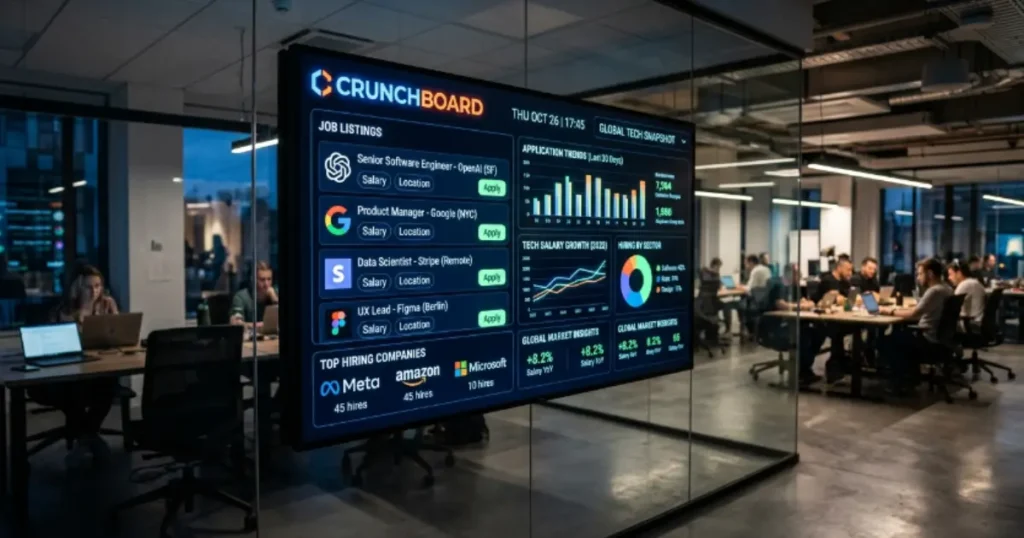
At its core, Crunchboard is a niche job board dedicated to technology, startup, and engineering roles. It operates under the TechCrunch umbrella, meaning every job listing benefits from exposure across TechCrunch’s website, daily newsletters, and social media channels. This is what separates Crunchboard from generic job boards: it isn’t just a database of listings, it’s plugged into an audience that already cares deeply about startups, venture capital, and emerging technology. Employers use Crunchboard to reach candidates who are already immersed in the tech ecosystem, while job seekers use it to discover roles at companies that are shaping the future of the industry, from early-stage startups to established scale-ups.
The Birth of TechCrunch: Setting the Stage
To understand Crunchboard, it helps to understand its parent brand. TechCrunch was founded in June 2005 by Michael Arrington and Keith Teare, partners at a venture studio called Archimedes Ventures. Arrington, a Southern California native who studied economics at Claremont McKenna College before attending Stanford Law School, had a background in law and startups, having worked at Wilson Sonsini Goodrich & Rosati and later at RealNames Corporation. What began as an internal research tool to track “Web 2.0” companies quickly evolved into one of the most influential technology publications in the world, breaking major stories long before they hit mainstream media.
From Blog to Media Powerhouse
TechCrunch’s credibility skyrocketed early on when Arrington’s reporting broke news of Google’s acquisition of YouTube, an event that transformed the site from a hobbyist blog into a serious news outlet. Arrington himself was later named one of Time magazine’s 100 Most Influential People. As TechCrunch’s readership grew into the millions, it became clear that the platform had built something valuable beyond news: a concentrated, loyal audience of founders, investors, engineers, and tech professionals. This audience would eventually become the foundation on which Crunchboard was built, giving the job board instant credibility that competitors could not easily replicate.
AOL’s Acquisition and the Expansion of the TechCrunch Ecosystem
In 2010, AOL acquired TechCrunch for an estimated $25 million, folding it into its growing digital media portfolio. This acquisition gave TechCrunch, and by extension its ancillary products like Crunchboard and CrunchBase, access to greater technical infrastructure and resources. Although the AOL era was marked by tension over editorial independence, which eventually led to Arrington’s departure in September 2011, the underlying business operations, including the job board, continued to grow steadily. During this period, TechCrunch expanded into new markets, including French, Chinese, and Japanese editions, further increasing the reach of its network and the audience available to job board clients.
Verizon Era: Stability Under a New Parent
Following AOL’s acquisition by Verizon Communications in 2015 for $4.4 billion, TechCrunch became part of Verizon Media, later restructured under the short-lived “Oath” brand before reverting to the Verizon Media name in 2018. Throughout these corporate shifts, Crunchboard continued operating as a dependable revenue stream and recruitment tool, largely insulated from the editorial controversies affecting the news side of the business. This era solidified Crunchboard’s reputation among employers as a stable, professional platform, even as ownership structures above it changed multiple times. TechCrunch’s monthly readership during this period consistently numbered in the millions, reinforcing the job board’s core value proposition.
The Apollo Global Management Era
A major turning point came in May 2021, when Verizon sold its media assets, including AOL, Yahoo, and TechCrunch, to private equity firm Apollo Global Management for approximately $5 billion. Apollo integrated these properties into a newly formed entity called Yahoo! Inc. This transition placed Crunchboard under yet another corporate structure, though its core function remained unchanged: connecting employers in tech and startups with qualified candidates through the TechCrunch audience. By this point, TechCrunch reported having roughly 400 employees and continued to be recognized as a leading authority on startup culture, technology news, and innovation.
Ownership Shift to Regent LP
In March 2025, Yahoo! Inc. sold TechCrunch to the private equity firm Regent LP, marking yet another chapter in the brand’s ownership history. This move renewed questions about the future direction of TechCrunch’s various products, including Crunchboard. While reports later surfaced suggesting a possible scale-back of TechCrunch’s European operations, TechCrunch’s Chairman and Publisher, Michael Reinstein, publicly denied that the site’s European operations had shut down. Through each of these ownership transitions, Crunchboard has remained active, continuing to serve as the dedicated recruitment arm of the broader TechCrunch media network.
How Crunchboard Works for Employers
For companies looking to hire, Crunchboard offers a streamlined process built around simplicity and reach. Employers can post job openings directly to the platform, choosing from a variety of paid packages since Crunchboard does not offer free listings. Once live, jobs are distributed across TechCrunch’s website, its daily newsletters, and its social media channels on platforms like Facebook and X. Employers can also purchase “job packs,” which allow multiple listings to be bought at once and, notably, never expire. This flexibility appeals particularly to startups with fluctuating hiring needs, as well as larger companies running ongoing recruitment campaigns throughout the year.
Featured Listings and Premium Visibility
Beyond standard postings, Crunchboard provides premium options designed to maximize visibility. Employers can mark a listing as “Urgent” to signal immediate hiring needs, or opt for a “Featured” placement, which pins the job to the top of the board for seven days. These premium features are particularly valuable in the competitive tech hiring landscape, where standing out among dozens of similar listings can make the difference between attracting top-tier engineering or product talent and being overlooked. Featured and urgent tags also tend to perform better in email newsletters, where visual hierarchy strongly influences click-through rates among job seekers browsing new openings.
Filtering and Discovery Tools for Job Seekers
On the candidate side, Crunchboard is built around practical, user-friendly discovery tools. Job seekers can filter listings by category, including software engineering, data science, marketing, SEO, and Web3 or crypto-related roles. Location and timezone-aware filtering allows remote workers and international candidates to find roles that match their preferred working arrangements, while a dedicated remote jobs filter caters to the growing segment of professionals seeking location-independent work. This combination of niche categorization and remote-friendly search options reflects broader shifts in the tech labor market, where flexibility and specialization have become just as important to candidates as salary and company reputation.
The TechCrunch Audience Advantage
What truly differentiates Crunchboard from broader platforms like Indeed or LinkedIn is the specificity and engagement level of its audience. TechCrunch has historically reported tens of millions of monthly readers, with the majority falling between the ages of 25 and 34, an age bracket that aligns closely with the core demographic actively job-hunting in tech and startups. Because visitors arrive already interested in startup news, funding rounds, and product launches, employers posting on Crunchboard are reaching a pre-qualified, highly relevant pool of candidates rather than a generic mass audience, which is a key reason startups continue to choose the platform despite its premium pricing.
Pricing and Market Positioning
Crunchboard operates as a premium, niche job board rather than a budget option. A single job posting has historically been priced around $349, positioning it above competitors like Authentic Jobs, which offers listings starting around $149. It sits below more specialized platforms like Dice, where plans can start at $495. This pricing reflects Crunchboard’s positioning: not the cheapest option, but a targeted one, built for companies willing to pay a premium for access to a curated tech-focused audience rather than a broad, generalist labor pool spanning every industry and skill set.
Comparing Crunchboard to Competing Job Boards
When evaluated against alternatives, Crunchboard’s strengths and limitations become clearer. Unlike Dice, it does not offer resume database searches or candidate-matching algorithms, keeping its feature set intentionally simple. Compared to Snagajob, which focuses heavily on hourly and service-industry work, Crunchboard is far more specialized toward salaried tech, engineering, and startup roles. This narrower focus is by design: rather than competing on breadth, Crunchboard competes on relevance, banking on its TechCrunch affiliation to deliver quality over quantity in both applicant volume and candidate fit for specialized technical positions.
Crunchboard’s Role in the Broader TechCrunch Ecosystem
Crunchboard doesn’t exist in isolation. It’s part of a broader constellation of TechCrunch-affiliated products that historically included CrunchBase (spun out independently in 2015 with funding from Emergence Capital) and the now-discontinued Crunchies awards show, which celebrated the tech industry’s top startups and personalities before ending in 2017. TechCrunch has also long hosted TechCrunch Disrupt, an annual conference launched in New York in 2010, where startups compete in “Startup Battlefield” pitch competitions. Companies like Dropbox and Uber gained early visibility through this event. Together, these products and events reinforce the ecosystem that gives Crunchboard its ongoing relevance and reach within the tech and startup community.
Industries and Job Categories Represented
Crunchboard’s listings span a wide range of tech-adjacent industries, reflecting the diversity of the broader startup economy. Software engineering and data science remain the most heavily represented categories, but the platform also regularly features postings in marketing, SEO, cryptocurrency and Web3, and gaming. This breadth allows Crunchboard to serve not just engineering-heavy startups but also growth-stage companies building out non-technical departments. For job seekers, this variety means the platform functions as more than a coding-jobs board; it acts as a general entry point into the wider startup employment landscape, provided listings remain active and current.
Criticism and Limitations Worth Noting
No platform is without drawbacks, and Crunchboard has faced its share of scrutiny, primarily around cost and feature limitations. Some reviewers note the absence of independent user reviews, making it harder for first-time employers to gauge satisfaction levels before committing to a paid package. The lack of a free posting tier can also be a barrier for early-stage startups operating on tight budgets, especially when compared to platforms offering freemium models. Additionally, the platform does not integrate with applicant tracking systems, meaning employers must manage the hiring pipeline manually or connect it to external recruitment software, which adds an extra layer of operational work.
Why Startups Still Choose Crunchboard
Despite these limitations, Crunchboard’s enduring appeal comes down to brand trust and audience quality. Being associated with TechCrunch, a name synonymous with startup journalism since 2005, lends immediate credibility to job listings. For early-stage companies trying to compete with larger, better-funded rivals for talent, that credibility can be a meaningful differentiator. Many hiring managers view the premium price as a worthwhile trade-off for reaching candidates who are already primed to understand startup culture, equity compensation, and the fast-paced nature of tech work, rather than sifting through applicants unfamiliar with the industry’s unique demands and expectations.
The Future of Crunchboard
With TechCrunch’s recent sale to Regent LP in 2025, questions naturally arise about how Crunchboard might evolve under new ownership. Historically, each change in TechCrunch’s corporate parent, from AOL to Verizon to Apollo, has left the job board’s core function largely intact, even as broader strategic priorities shifted around it. Given the continued demand for specialized tech recruitment platforms, it’s reasonable to expect Crunchboard will continue serving startups and job seekers going forward, potentially with updated features or pricing models reflecting the ongoing evolution of remote work and AI-driven hiring tools across the recruitment industry.
Conclusion
The story of Crunchboard is inseparable from the story of TechCrunch itself, a media brand born in 2005 that weathered acquisitions by AOL, Verizon, Apollo, and most recently Regent LP, while consistently maintaining its core identity as tech journalism’s leading voice. Through every ownership change, Crunchboard has persisted as a trusted, niche recruitment tool, leveraging TechCrunch’s engaged readership to connect employers with specialized tech talent. While it may not offer every bell and whistle found on larger, generalist job boards, its focused audience and brand credibility continue to make it a relevant choice for startups and tech companies serious about hiring well in a competitive, fast-moving industry.
Frequently Asked Questions (FAQs)
1. What is Crunchboard used for? Crunchboard is a job board used primarily by tech companies and startups to post job openings and reach candidates through TechCrunch’s engaged audience of readers, newsletter subscribers, and social media followers.
2. Is Crunchboard free to use for employers? No, Crunchboard does not offer a free job posting option. Employers must purchase a listing package, with pricing historically starting around $349 per post.
3. Who owns Crunchboard today? Crunchboard operates under TechCrunch, which was sold by Yahoo! Inc. to private equity firm Regent LP in March 2025, following earlier ownership by Apollo Global Management, Verizon, and AOL.
4. How is Crunchboard different from LinkedIn or Indeed? Unlike broad, generalist platforms, Crunchboard targets a specialized, tech-savvy audience through its affiliation with TechCrunch, making it better suited for startup and engineering-specific hiring rather than general job searches.
5. Does Crunchboard offer remote job filtering? Yes, Crunchboard includes location and timezone-aware filtering, along with a dedicated remote jobs category, making it easier for candidates to find location-flexible opportunities.
6. What types of jobs are listed on Crunchboard? Listings commonly include software engineering, data science, marketing, SEO, Web3 and crypto roles, and gaming industry positions, reflecting the broader startup and tech ecosystem TechCrunch covers.
7. Is Crunchboard connected to CrunchBase? No, CrunchBase spun out as an independent company in 2015 with funding from Emergence Capital and is a separate entity from Crunchboard, though both originated within the TechCrunch ecosystem.