
Few names in the modern aerospace industry generate as much curiosity as Auriga Space. Founded in 2022, this California-based startup is challenging a century-old assumption: that reaching orbit requires burning enormous amounts of chemical propellant. Instead, Auriga Space is building an all-electric, reusable launch system powered by electromagnetism. From humble beginnings in a small engineering facility to signing contracts with the U.S. Department of Defense, the company’s journey is a compelling case study in aerospace innovation. This article takes a deep dive into the history, technology, leadership, and future of Auriga Space, exploring why it has become one of the most closely watched names in the “New Space” economy.
What Is Auriga Space?
Auriga Space is a privately held aerospace and defense technology company headquartered in Garden Grove, California. The company designs electromagnetic launch systems that replace the traditional first-stage rocket booster with a ground-based accelerator track. Instead of burning fuel to escape Earth’s atmosphere, payloads are propelled using precisely timed magnetic fields, similar in principle to a maglev train. Auriga Space describes its mission as building “clean systems that can outperform traditional ones” in real-world performance, not just theory. The company serves both commercial satellite operators and government defense agencies, positioning itself as a dual-use technology provider capable of supporting hypersonic testing, counter-drone defense, and orbital launch simultaneously.
The Origin Story: How Auriga Space Began
The idea behind Auriga Space was born out of frustration with the inefficiency of conventional rockets. In most rocket launches, over 90% of total vehicle mass is fuel, while less than 2% of the mass actually reaches orbit. Recognizing this imbalance, the founding team set out in 2022 to design a fundamentally different launch architecture. Rather than relying on chemical combustion, Auriga Space proposed using high-powered magnets to accelerate a vehicle to hypersonic speeds along a ground track before a small onboard engine completes the final push into orbit. This approach promised dramatic reductions in cost, turnaround time, and environmental impact compared to legacy rocket systems.
Winnie Lai — The Visionary Behind Auriga Space
At the center of Auriga Space’s founding story is Winnie Lai, the company’s Founder and CEO. Lai holds a Bachelor’s degree in Electrical Engineering and Physics from the University of British Columbia, completed between 2005 and 2010. Before launching Auriga Space, she served as VP of Product and Business Development at SpinLaunch, another kinetic-launch startup, and later worked as an Entrepreneur in Residence at Launchpad Capital. This combination of hands-on aerospace engineering experience and startup leadership gave Lai the technical grounding and business acumen needed to found her own venture. Her guiding philosophy, often repeated in interviews, is that space access should be as fast and reliable as calling a rideshare.
The Technology Behind Auriga Space’s Launch System
The core innovation at Auriga Space lies in its electromagnetic acceleration track. Unlike vertical rocket launches, the system uses a ground-based tunnel lined with magnetic coils. When electricity flows through these coils, it generates a controlled magnetic field that pushes a payload-carrying sled down the track at extreme velocity. As the track curves upward toward its final segment, the vehicle exits at several times the speed of sound before a small rocket engine ignites for the final leg into orbit. Because the entire launch structure is powered by standard electrical infrastructure — wall outlets, generators, or renewable sources — Auriga Space eliminates much of the complexity, cost, and emissions tied to conventional propellant-based boosters.
How Electromagnetic Launch Works
To understand why Auriga Space’s system is considered revolutionary, it helps to break down the physics. The company’s accelerator functions much like a railgun or maglev train, using precisely timed pulses of electromagnetic energy to push a vehicle along a fixed track. Because the acceleration happens on the ground rather than in the air, engineers can build the track to be fully reusable, testable, and adjustable for different mission profiles. Auriga Space has noted that recent advances in power electronics, particularly the ability to safely operate at higher voltages and power levels, have finally made this decades-old concept commercially and technologically viable at scale.
Comparing Auriga Space to Traditional Rocket Launches
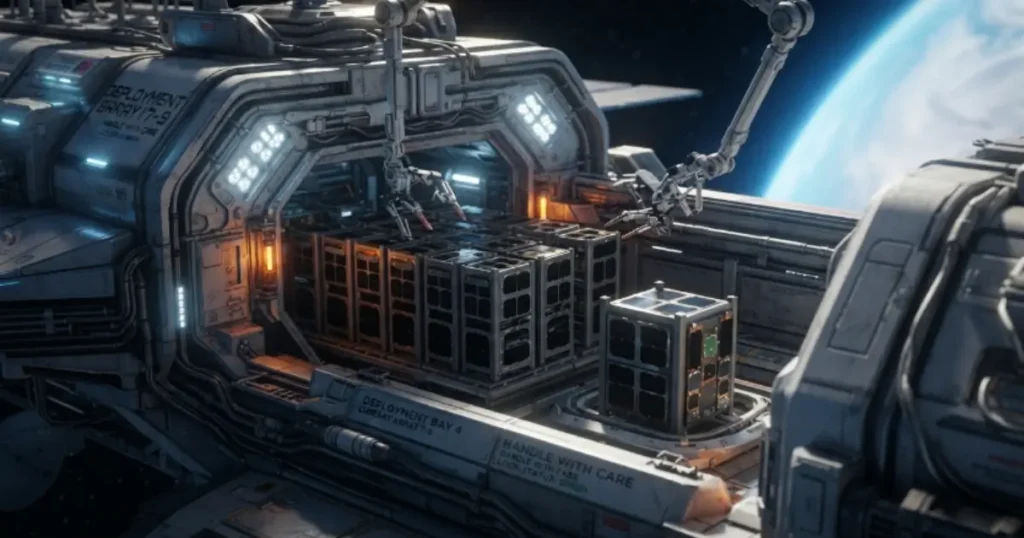
Traditional orbital rockets rely on multiple stages of chemical propellant, each of which is expended and often discarded during ascent. This makes conventional launches expensive, resource-intensive, and difficult to schedule on short notice. Auriga Space, by contrast, aims to make its ground-based launch infrastructure reusable across many flights per day, dramatically increasing launch cadence while lowering per-launch costs. The company also emphasizes environmental benefits, since electromagnetic acceleration produces far fewer emissions than burning rocket fuel. This positions Auriga Space as a potential answer to the growing global demand for frequent, low-cost, and more sustainable access to space.
Auriga Space’s Mission and Vision
Auriga Space’s long-term vision extends beyond simple satellite deployment. The company has stated ambitions to enable “surface-to-space launch for the Moon and beyond,” supporting sustained lunar operations in the coming decades. In the nearer term, Auriga Space is focused on serving the U.S. Space Force’s demand for “responsive launch” — the ability to get a payload into orbit with little or no advance notice. CEO Winnie Lai has compared this goal to ordering a rideshare, where a vehicle arrives within minutes rather than after weeks of preparation. This responsiveness, combined with lower costs, is central to how Auriga Space positions itself against both legacy launch providers and newer commercial rivals.
Key Milestones and Achievements
Since its founding, Auriga Space has reached several notable milestones that highlight its growing credibility in the aerospace and defense sectors. These achievements span funding rounds, government contracts, and strategic industry partnerships, each reinforcing the company’s technical and commercial progress.
Seed Funding and Early Investors
Auriga Space first emerged from stealth mode with an initial $5 million in funding to support prototyping and expand its Los Angeles-area facility. The company later disclosed a $4.6 million seed round, led by European venture firm OTB Ventures, with participation from Trucks Venture Capital and Seraphim Space. Additional backers include Possible Ventures, Unlock Venture Partners, DNX Ventures, Monte Carlo Capital, Vermilion Ventures, Heuristic Capital, Story Ventures, PaperJet Ventures, Syndicate 708, Kern Venture Group, and Automotive Ventures. Altogether, Auriga Space has raised more than $11 million in venture capital and government grants, according to industry funding trackers.
AFWERX and SpaceWERX Contracts
Beyond venture funding, Auriga Space has secured government backing through defense innovation programs. In August 2024, the company was selected for a Direct-to-Phase II Small Business Innovation Research (SBIR) contract through AFWERX, worth approximately $1.4 million, alongside additional SpaceWERX funding. These contracts reflect growing interest from the U.S. Department of Defense in electromagnetic launch as a tool for both hypersonic testing and responsive space access, validating Auriga Space’s dual-use business strategy.
Hypersonic Materials Testing Partnership with Axiom Materials
In a significant industry-first move, Auriga Space launched a hypersonic materials testing capability, with Axiom Materials serving as its pilot customer. This service allows aerospace manufacturers to test how materials perform under extreme hypersonic conditions using Auriga Space’s ground-based acceleration track, rather than relying solely on limited and expensive wind-tunnel facilities. This diversification into testing services has allowed Auriga Space to generate revenue and refine its technology ahead of full orbital launch capability.
University of North Dakota MOU
Auriga Space also signed a Memorandum of Understanding (MOU) with the University of North Dakota to collaborate on advancing hypersonics, counter-UAS (unmanned aerial systems), and space technologies. Partnerships like this allow Auriga Space to tap into academic research resources while helping train the next generation of aerospace engineers on emerging launch technologies.
Auriga Space’s Products and Services
While best known for its ambitions in orbital launch, Auriga Space currently offers several distinct product lines that generate near-term commercial value while the company scales toward full launch capability.
Ground-Based Hypersonic Testing
One of Auriga Space’s primary offerings today is recoverable, high-cadence, flight-representative hypersonic testing conducted entirely on the ground. This allows defense contractors and materials companies to simulate extreme flight conditions without the cost of an actual launch.
Surface-to-Space Launch Platforms
Looking ahead, Auriga Space’s flagship product remains its surface-to-space launch platform, designed for on-demand and affordable access to orbit. The company envisions this platform eventually supporting lunar surface operations as well.
Counter-UAS and Defense Applications
Auriga Space’s electromagnetic technology also has direct defense applications, including the dynamic deployment of unmanned vehicles, targets, decoys, and counter-UAS effectors. This makes the company’s technology attractive not just for civilian space access, but for military testing and interceptor systems as well.
Why the Name “Auriga”? The Meaning Behind Auriga Space
The name Auriga Space is drawn from Auriga, a constellation in Greek mythology that depicts a chariot rider. This symbolism reflects the company’s mission of “driving” payloads into space using a powerful, controlled mechanical force rather than explosive combustion. Just as a charioteer commands speed and direction with precision, Auriga Space’s electromagnetic track is designed to accelerate vehicles with tightly controlled timing and trajectory, a fitting metaphor for the company’s engineering philosophy.
Auriga Space’s Location and Facilities
Auriga Space operates a vertically integrated research and development facility in Garden Grove, located in Orange County, California. This hands-on, in-house approach allows the company to design, build, and test nearly every component of its launch system without relying heavily on external suppliers. According to the company, this structure enables faster iteration and helps engineers push beyond the limitations typically associated with conventional aerospace manufacturing timelines.
Investors and Financial Backing
As detailed earlier, Auriga Space has attracted a diverse group of institutional and strategic investors, spanning aerospace-focused funds like Seraphim Space to mobility-focused firms like Automotive Ventures. The company’s advisory board includes notable industry figures such as Ashley Fieglein Johnson, a veteran of Planet Labs, and Blake Scholl, founder of supersonic aviation company Boom Supersonic. This blend of financial backing and experienced advisors has helped position Auriga Space as a credible contender in the competitive New Space launch sector.
Competitors in the Electromagnetic Launch Industry
Auriga Space does not operate in isolation. Several other companies are pursuing similar kinetic or electromagnetic launch concepts, including SpinLaunch, where CEO Winnie Lai previously worked. Other competitors identified across industry databases include Exos Aerospace, Interorbital Systems, Orbex, and Astron Systems, each pursuing alternative approaches to reducing launch costs. While these companies share a broad goal of disrupting traditional rocketry, Auriga Space differentiates itself through its dual focus on commercial launch and defense-oriented hypersonic testing, giving it multiple potential revenue streams while its core launch technology matures.
Challenges Facing Auriga Space
Like any company attempting to commercialize a fundamentally new form of propulsion, Auriga Space faces significant technical and financial hurdles. Building a track long enough to achieve orbital velocities while keeping G-forces within survivable limits for sensitive payloads remains an open engineering challenge. The company has acknowledged that its final system architecture, including track length and vehicle size, is still being finalized. Additionally, as a privately held startup, Auriga Space must continue securing funding and government contracts to sustain its research and development timeline before achieving a fully operational orbital launch system.
The Future of Auriga Space
Despite these challenges, Auriga Space appears to be steadily building momentum. With growing government interest in responsive launch capabilities, an expanding list of institutional partnerships, and a diversified revenue model that includes hypersonic testing services, the company is well-positioned within the broader New Space economy. If Auriga Space successfully scales its electromagnetic launch track to orbital velocities, it could meaningfully reshape how satellites, defense payloads, and eventually lunar cargo are sent beyond Earth’s atmosphere, offering a faster, cheaper, and cleaner alternative to traditional rocketry.
Conclusion
Auriga Space represents one of the more ambitious bets in today’s commercial aerospace landscape. Founded by Winnie Lai in 2022, the company has moved from a bold idea about electromagnetic propulsion to a functioning business with real government contracts, paying commercial customers, and a growing list of institutional investors. While the road to full orbital launch remains technically demanding, Auriga Space’s progress so far — from its Garden Grove R&D facility to its hypersonic testing partnerships — suggests a company methodically building toward a larger goal. Whether or not Auriga Space ultimately achieves fully electromagnetic orbital launch, its work is already contributing meaningfully to the broader conversation about sustainable, responsive access to space.
Frequently Asked Questions About Auriga Space
1. What does Auriga Space do? Auriga Space develops electromagnetic launch systems designed to send payloads into orbit using magnetic acceleration instead of traditional rocket propellant, while also offering hypersonic ground-testing services.
2. Who founded Auriga Space? Auriga Space was founded by Winnie Lai in 2022. She previously worked at SpinLaunch and Launchpad Capital before starting her own company.
3. Where is Auriga Space located? Auriga Space is headquartered in Garden Grove, California, within Orange County, where it operates a vertically integrated research and manufacturing facility.
4. How much funding has Auriga Space raised? Auriga Space has raised more than $11 million through a combination of venture capital rounds and government contracts, including a $4.6 million seed round and AFWERX/SpaceWERX defense funding.
5. How is Auriga Space different from traditional rocket companies? Unlike traditional rockets that rely heavily on chemical propellant, Auriga Space uses a ground-based electromagnetic track to accelerate vehicles to hypersonic speeds before a smaller engine completes the trip to orbit, aiming for lower costs and higher launch frequency.
6. Does Auriga Space work with the military? Yes. Auriga Space holds contracts with the U.S. Department of Defense through programs like AFWERX and SpaceWERX, supporting applications such as hypersonic testing and counter-UAS technology.
7. Why is the company called Auriga Space? The name comes from Auriga, a constellation from Greek mythology representing a chariot rider, symbolizing the company’s mission of precisely “driving” payloads into space.