
For millions of families, watching a parent grow older or caring for a disabled adult child raises one urgent question: how do you find them safe, affordable housing without draining your savings? The Family Opportunity Mortgage answers that question. It is a special financing path built into Fannie Mae and Freddie Mac guidelines that lets a qualified borrower purchase a home for an elderly parent or a disabled adult child, while still receiving the same low rates and small down payments normally reserved for a primary residence. This article breaks down its history, how it works, who qualifies, and how to apply in 2026, so you can make an informed, confident decision for your family.
What Is a Family Opportunity Mortgage?
A Family Opportunity Mortgage is not a separate loan product sold off a shelf. It is a special occupancy exception written into conventional loan guidelines. Normally, if you buy a house you won’t personally live in, lenders classify it as a second home or investment property, both of which carry higher interest rates, stricter underwriting, and larger down payments. The Family Opportunity exception changes that classification. It allows the home to be treated as owner-occupied, even though the person signing the loan does not live there, as long as the occupant is a parent or disabled adult child who cannot qualify for a mortgage independently. This single distinction can save a family tens of thousands of dollars over the life of the loan.
The Origin and Background of the Program
The concept traces back to Fannie Mae’s Selling Guide, which has long recognized that a “principal residence” can, under specific conditions, include a property occupied by someone other than the borrower. The term “Family Opportunity Mortgage” became popular shorthand among loan officers and borrowers in the 2000s, even though Fannie Mae itself never marketed it under that brand name. Today, the official program name has technically been retired, but the underlying guideline — allowing owner-occupied financing for a parent or disabled child — remains fully active. Freddie Mac maintains a nearly identical exception in its Single-Family Seller/Servicer Guide, giving families a second avenue if a Fannie Mae lender is not the right fit.
Why the Program Exists
Housing affordability and long-term care costs have both climbed sharply, leaving many retirees and disabled adults unable to qualify for a mortgage on fixed incomes such as Social Security. Without this guideline, families wanting to help would be forced into investment-property financing, which typically demands 20% to 30% down and charges meaningfully higher interest rates. Fannie Mae and Freddie Mac created this pathway to keep families together, reduce reliance on costly assisted living facilities, and allow adult children to build equity in a property while genuinely improving a loved one’s quality of life. It reflects a broader industry recognition that housing decisions are often family decisions, not purely individual ones.
Who Qualifies for a Family Opportunity Mortgage
Two primary scenarios fall under this guideline, and some lenders extend a related allowance to college students.
Scenario One: An Adult Child Buying for an Elderly Parent
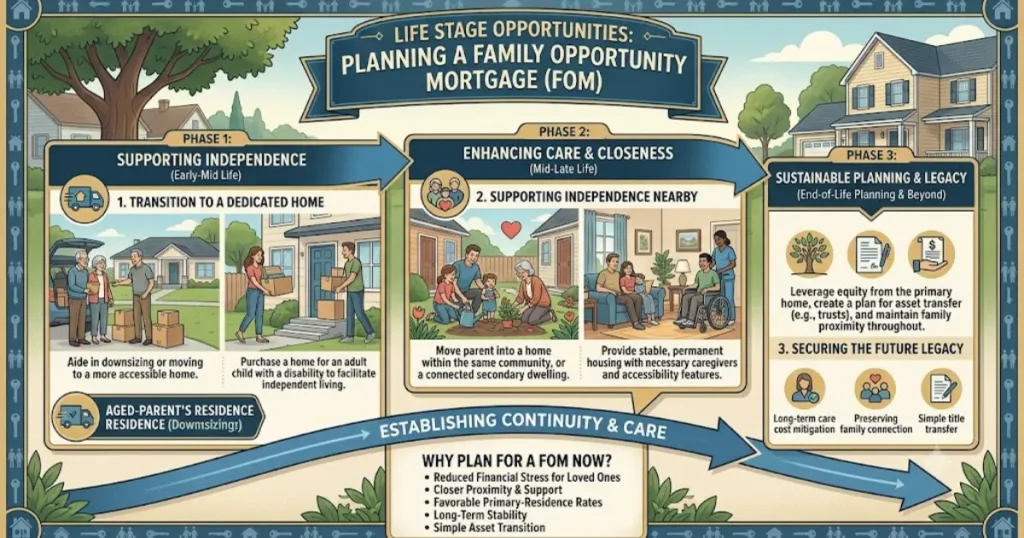
Here, the parent must be unable to work or lack sufficient income to qualify for a mortgage on their own. The adult child applies for the loan, qualifies based on their own credit and income, and makes the monthly payments, while the parent lives in the home as their primary residence.
Scenario Two: A Parent Buying for a Disabled Adult Child
In this reversed scenario, a disabled adult child cannot independently qualify for financing. The parent purchases and finances the property, and the adult child occupies it as their primary residence, receiving stable, long-term housing.
A Lesser-Known Option: College Students
Some lenders also apply the guideline when a child is enrolled in college, allowing parents to buy a home near campus at owner-occupied rates, provided the student lives there as their primary residence and enrollment can be documented.
Core Eligibility Requirements
To use a Family Opportunity Mortgage, the person taking out the loan must satisfy standard conventional loan criteria. Lenders generally require a minimum credit score of 620, although scores of 680 or higher typically unlock meaningfully better pricing. Debt-to-income (DTI) ratio is a critical factor because the borrower’s income must support both their own housing costs and the new mortgage payment. Fannie Mae guidelines generally cap DTI at 36% to 45%, with exceptions up to 50% allowed for borrowers with strong compensating factors such as significant cash reserves or excellent credit. Steady employment, ideally two or more years in the same field, is also expected to demonstrate reliable future income.
Required Documentation
Because the family member’s inability to qualify independently is central to this guideline, lenders require specific proof. This typically includes a Social Security award letter or documentation showing the parent’s limited income, along with proof of the family relationship if last names differ. For a disabled adult child, medical or disability-benefit documentation is generally required. Borrowers must also submit the usual conventional mortgage paperwork: pay stubs, tax returns, bank statements, and employment verification. Because underwriters must confirm both financial eligibility and the family circumstance, working with a lender experienced in this niche guideline significantly reduces delays and confusion during processing.
Down Payment and Interest Rate Advantages
The single biggest benefit of the Family Opportunity Mortgage is pricing. Because the loan is classified as owner-occupied rather than an investment property, borrowers may qualify for a down payment as low as 5%, and in some cases 3% through programs like HomeReady. Interest rates are typically 0.5% to 1% lower than investment property loans, and closing costs are reduced as well. On a $200,000 home, the lower down payment requirement alone can reduce upfront costs by roughly $30,000 to $40,000 compared with an investment property loan, a difference that often determines whether a purchase is financially feasible at all.
Family Opportunity Mortgage vs. Second Home Loans
Second home loans, sometimes called vacation home loans, usually require the property to sit 50 to 100 miles away from the borrower’s primary residence. That restriction makes little sense for a family wanting to keep an aging parent nearby for caregiving. The Family Opportunity guideline removes this distance requirement entirely — the parent’s home can be next door, across town, or across the country. This flexibility is one of the clearest reasons families choose this route over a standard second-home classification whenever the occupant is a qualifying relative.
Family Opportunity Mortgage vs. Investment Property Loans
Investment property loans are built for landlords, not caregivers. They typically demand 20% to 30% down, carry stricter credit and reserve requirements, and charge noticeably higher interest rates because lenders view rental income as less predictable than an owner living in the home. The Family Opportunity exception avoids all of this by treating the transaction as owner-occupied, provided the occupying relative genuinely cannot qualify independently. Misusing this guideline to secure investment-property benefits under false pretenses is considered mortgage fraud, carrying serious legal and financial consequences, including loan recall.
2026 Conforming Loan Limits
Because Family Opportunity loans are conventional mortgages, they must stay within conforming loan limits set annually by the Federal Housing Finance Agency (FHFA). For 2026, the baseline conforming loan limit for a one-unit property across most of the United States is $832,750, with higher limits permitted in designated high-cost housing markets. Borrowers seeking financing above these thresholds would need to explore jumbo loan options, which do not carry the same owner-occupied exception.
The Role of Freddie Mac
While Fannie Mae’s guideline is the most widely referenced version of this program, Freddie Mac offers a comparable exception for family housing situations. This matters because not every lender sells loans exclusively to Fannie Mae. Having a parallel Freddie Mac option expands the pool of lenders and loan officers who can process this type of transaction, giving families more room to shop for competitive rates and terms rather than being limited to a single investor’s guidelines.
Tax Considerations to Discuss With a Professional
Owning a home that a family member occupies rather than the titleholder introduces tax complexity. Questions around mortgage interest deductions, property tax treatment, potential gift tax implications if payments are subsidized, and eventual capital gains upon sale all deserve attention. Because rules vary based on individual circumstances and can change with tax law updates, consulting a CPA or tax attorney before closing is strongly recommended. This is also a good moment to discuss whether adding the occupying family member to the property deed makes sense for estate planning purposes.
Finding the Right Lender
Because the official “Family Opportunity Mortgage” name has been retired, borrowers won’t find a clean, brandable product listed on a lender’s website. Instead, when shopping for a mortgage, ask directly: “Are you familiar with Fannie Mae’s owner-occupied guidelines for a parent or disabled adult child who can’t qualify independently?” A lender who immediately understands and confirms they process these regularly is a strong sign. If a loan officer seems confused or pushes investment-property financing without listening, that is a red flag. National lenders that handle high mortgage volumes, along with experienced mortgage brokers who work across multiple investors, are generally your best resources.
Step-by-Step Application Process
Successfully securing this type of financing follows a clear sequence. First, get pre-approved so you understand your maximum purchase budget while accounting for your existing housing costs. Second, gather documentation proving your relative’s inability to qualify independently, such as a Social Security award letter or disability records. Third, work with a real estate agent to find a property matching your family member’s physical and medical needs. Fourth, submit your full application, emphasizing the owner-occupant classification to your underwriter. Finally, close the loan, at which point your relative can move in while the mortgage and deed remain in your name unless otherwise arranged.
Benefits Beyond the Numbers
While the financial savings are significant, the emotional value of this program is just as important. Instead of transitioning a parent into assisted living or a nursing facility, many families find that a modest home’s monthly mortgage payment costs far less than long-term care, while simultaneously building equity in a real asset. For a disabled adult child, homeownership through a parent’s financing can offer independence, dignity, and long-term housing security that renting alone may not provide. These non-financial benefits are frequently what motivate families to pursue this path in the first place.
Potential Drawbacks to Consider
This guideline is not without challenges. Carrying two housing payments simultaneously requires strong, verifiable income, and lenders will scrutinize your complete financial picture closely. Not every lender is familiar with the guideline, which can slow the shopping process. Tax and estate-planning implications add complexity that a standard home purchase does not carry. Finally, because the occupying relative must live there as a genuine primary residence, the property cannot later be converted into a short-term rental or vacation home without violating the terms of the original loan.
Conclusion
The Family Opportunity Mortgage remains one of the most valuable, underused tools available to families navigating the financial realities of aging parents or the housing needs of a disabled adult child. By unlocking owner-occupied rates, smaller down payments, and no distance restrictions, it turns what would otherwise be an expensive investment-property purchase into an achievable, affordable solution. Success depends on working with a knowledgeable lender, preparing the right documentation, and understanding both the benefits and responsibilities involved. For the right family, in the right circumstances, this guideline can be the difference between a loved one living independently in a home of their own, or facing far costlier alternatives.
Frequently Asked Questions
1. Is the Family Opportunity Mortgage a real loan program? It is not a standalone branded product but a recognized exception within Fannie Mae and Freddie Mac conventional loan guidelines that allows owner-occupied financing for a qualifying family member.
2. What credit score do I need to qualify? Most lenders require a minimum score of 620, though 680 or higher typically secures better interest rates and terms.
3. Can I use this program to buy a home for a sibling or grandparent? The guideline is specifically designed for parents and disabled adult children. Other family relationships generally do not qualify under this exception.
4. Does my parent or disabled child need to be on the loan? No. The borrower who qualifies financially takes out the loan and makes the payments, while the family member simply occupies the home.
5. How much down payment is required? Down payments can be as low as 5%, or 3% under certain programs like HomeReady, since the loan is treated as owner-occupied.
6. Is there a distance requirement, like with second home loans? No. Unlike second home loans requiring 50–100 miles of separation, the Family Opportunity guideline has no distance restriction.
7. What happens if I misuse this guideline for a rental property? Misrepresenting occupancy to obtain owner-occupied rates is considered mortgage fraud, which can result in loan recall and legal consequences.